International students leave homes to build their American dreams, where immigration policy determines every major life decision.
Just before leaving through a door to get immigration biometric scans, Kai Teoh jokingly wished his partner goodbye — just in case he wouldn't see her again.
"We came up with these things, maybe it was paranoia, but based on what we were seeing, it was terrifying, right?" Teoh said.
Teoh moved to the U.S. when he was 18 years old. Originally from Malaysia, he navigated three different visas before finally earning permanent residency and the highly coveted green card that so many immigrants like him hope to obtain.
He described a journey of ups and downs, and fear that at any moment his status could be revoked. If he was deported, he would have to upend his whole life and return to Malaysia, after years building a life in the U.S.
"I've only traveled back home twice in my life here. I was always juggling visas and all these priorities," Teoh said.
Kai Teoh moved to the U.S. at 18.
Though the details of the journey for Teoh are unique, the stressed emotions are the same for so many like him. Outside of scores of undocumented immigrants and asylum seekers, there are 2.9 million people on student and temporary work visas that struggle to establish a home in the U.S., jumping through bureaucratic hoops, challenging work environments, and are often overlooked in the news.
These stories reflect the journeys of countless international students who leave homes to build their American dreams, where immigration policy determines every major life decision.
The Rocky Road to Sponsorship
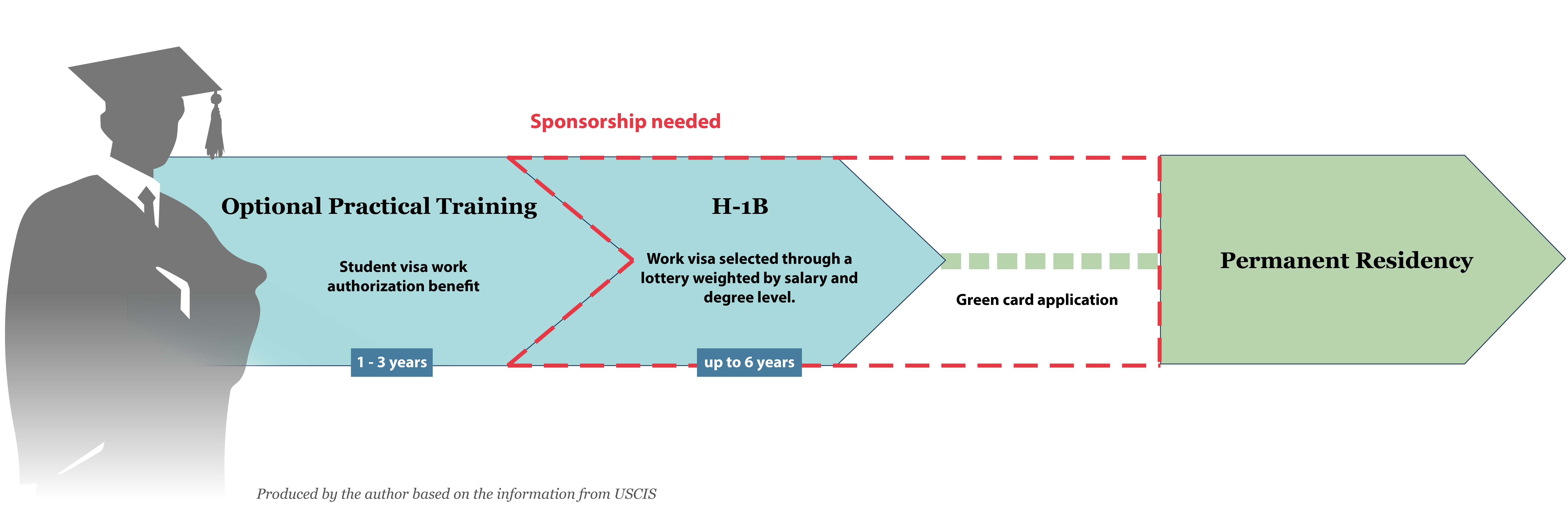
For many international students, the road to a green card is a decade-long marathon. As soon as they graduate, they must find a job within a short period of time, and one at a company willing to sponsor their visa, to remain in the U.S. to pursue immigration.
Post gradudation Pathways
Teoh, an experienced news developer, was once barred from taking a programming role in a newsroom due to restrictive policies, despite having already received a verbal offer. "The [interview] conversations always slowed down when the topic turned to visas," Teoh recalled. Teoh is a journalism major and under immigration policy, a person's major has to match their work position.
Another time, a company backed out of a promised visa sponsorship at the last minute. Teoh accepted a pay cut for that role, moved his family and successfully completed projects. But when he asked when the company would begin his green card process, the only thing he received was disappointment.
"They would brag about my project in meetings," Teoh said. "But when I asked, when can we start my green card process, [the editor] questioned my dedication to the company. I was pretty desperate at that point."
This Is Not the First Time
Ambiguous rhetoric from President Donald Trump, uncertainty around immigration rules and heightened scrutiny in visa issuance have become major sources of uncertainty.
Last September, when The White House announced it would impose certain nonimmigrant workers a $100,000 fee, there was an uproar in the international students community. They were heatedly discussing the possibility of securing jobs, receiving sponsorship and the impact of renewing the current H-1B visas.
In the following month, U.S. Citizenship and Immigration Services (USCIS) clarified that the new $100,000 fee does not apply to a petition filed inside the U.S. This updated guidance released the main anxiety; however, repeated announcements of vague policies have caused a sense of instability.
While the job-hunting process may appear straightforward, the reality is that some students lose their offers if their work visas aren’t approved by the expected start date.
Data showed that work authorization visa processing times can last more than four months.
Adam (pseudonym), Silicon Valley engineer.Sketch details altered.
Adam, who requested a pseudonym to protect his identity because he fears
retaliation from immigration officials for speaking out on this issue,
is a 33-year-old engineer in Silicon Valley. He had to take the current
position which was not his first choice, because of a paperwork oversight
during his work visa transfer.
Graduating in 2022, Adam didn't face a job market that was as tough as it is now. New grads in the recent two years were not that lucky.
Trinity Chiu, 25, came to the U.S. to pursue a master's degree at Southern California University. Previously, she spent eight months looking for an internship but ended up accepting an unpaid one, just to get local working experience in the competitive job market. At the time, she had a better-paid internship in her home country, but she knew that gaining work experience in the U.S. would be far more important if she wanted to stay after graduation.
Trinity Chiu, a recent graduate.
Making Difficult Decisions
Loss of immigration status compelled some into other major life decisions like marriage. Take Ariel, who requested to use a pseudonym to protect her identity because she fears U.S. administration retaliation, is a Chinese 24-year-old recent graduate. When her student visa expired, it put a strain on her relationship, since her boyfriend was in the U.S. and she had to return to China. She was faced with a dilemma: To return to the U.S. she could marry her boyfriend, a U.S. Citizen, but she wasn't ready to take that step in her relationship.
Ariel went back to China as her visa expired.Sketch details altered.
“Especially after I came back and talked with my friends here, I realized that I had to make many significant decisions in my early twenties because of visa status.” Ariel said.
When visas are involved, relationships can become a factor and get complicated. When conflicts in relationships arise, visa pressure may become a last straw, making it difficult for couples to have the freedom to break up. In some cases, it creates a sense of power imbalance between partners.
Most U.S. citizens may not be familiar with how visas work, and Ariel's partner is no exception. When Ariel explained that marriage could be an option to stay in the U.S., she felt extremely awkward.
"To some extent I feel like he has a higher status than me," Ariel said, comparing herself to the poor woman dating a wealthy man in dramas. She also worried about how his family might view her relationship, fearing it could be seen as strategic rather than genuine.
Handling visa situations independently may feel more feasible for couples who are at a relatively stable stage of life, but the outcome does not match what they hope for.
While Teoh was already engaged to his partner for years, he insisted on getting married only after obtaining a green card through his employer's sponsorship. Everything had been on track until last year, when the tense political climate raised concerns for Teoh and his partner, prompting them to get married earlier than planned. It took only two weeks from making the decision to the courthouse ceremony.
Despite Teoh repeatedly proving his value at work, he received uncomfortable suggestions people often offer: marry your partner as it is the easiest way. "It's insulting, right? [Society] tells everybody you're about meritocracy and now you tell me that I should just find somebody and get married?" Teoh emphasized.
For Ariel and Teoh, immigration policy became a constant thorn in their romantic relationships.
University Saw Fewer International Students
The number of international students arriving in August took a sharp dip, according to the International Trade Administration. In 2025, there were nearly 74,000 fewer students arriving in the U.S. compared to last August, the typical time when students arrive for the fall semester begins.
While the number of international students is increasing, there has been a 7 percent decline in the number of new international students enrolling for the first time at U.S. colleges and universities, Opendoors found.
The decline could impact the U.S. economy. According to NAFSA, international students contribute about $43 billion to the U.S. economy during the 2024-25 academic year. Colleges may also be impacted, since international students often pay higher tuition.
Michael Crow, president of Arizona State University, wrote in an opinion piece in The Wall Street Journal that the U.S. should recognize international students in spreading American values after they return home beyond their economic contributions.
Juanita Darling, a professor of international relations at San Francisco State University, highlighted in the New York Times that international students bring global networks, encouraging local students to study abroad.
Roger D. Cone, director of the Life Sciences Institute at the University of Michigan, wrote in his letter to the New York Times that faculty members, students, and trainees from 36 countries make up the diverse institute where he works. In his view, recruiting the best talent from around the world is a key aspect of American greatness.
Uncertain Futures
While many international students hope to build a life in the U.S., some not lucky enough to win the H-1B lottery find opportunities to travel.
Mata Chan, a 27-year-old Instagram content creator from Taiwan, came to the U.S. in 2022 to study at New York University. After graduating and working for nearly a year he wasn't selected for an H-1B, and returned to his hometown Taoyuan.
To Mata, not getting selected wasn't all bad. "I always wanted to live in Europe, and I always wanted to explore any possibility other than devoting most of my time to work in my 20s," Chan said.
Chan is now living in Japan, continuously documenting his daily life for audiences. In one of his videos, he shared that he has applied for a visa to Europe.
"It felt eerily similar to applying for the U.S. visa years ago," Chan wrote in his blog. He aspired to pursue a different life from mainstream social expectations in East Asia, and he was able to bear with changeable environments and experience his life in his young age.
Chan is passionate about documenting his life on social media platforms.
Chan said that in his interactions with international student audiences, he has noticed that most hope to stay in the U.S. after graduation. People like him, who feel less attached to that outcome, may be relatively rare.
Many international students are coming to the U.S. for an advanced education system and a better job opportunity. While the shifting immigration policies have begun to cast doubt on the reason they came here, they have learned to do their best and accept whatever outcome may follow.
"Being an international student seems to be getting harder," Trinity Chiu said. "At some point, you just have to stay calm and deal with it."
Some interviewees’ names have been changed to protect their identity.